Allow 35–50 minutes. This walk connects three works whose locations help explain how Yale manages institutional memory, protest, conservation, and campus change. Begin at Maya Lin’s Women’s Table on Rose Walk. Then continue to the Yale University Art Gallery sculpture garden for Claes Oldenburg’s Lipstick (Ascending) on Caterpillar Tracks and Alexander Calder’s Gallows and Lollipops, checking current on-view information because the latter two have moved.
Use the same sequence for each work: look at its present setting, establish the documented background, then follow its location history. Moving a sculpture can alter who encounters it, how it is supervised, and what kind of gathering it can support.
Women's Table: an institutional timeline in a daily path
Present setting
On Rose Walk right beside Sterling Memorial Library, look down at a low elliptical table crafted from dark stone. A thin layer of water crosses its surface, revealing a carved spiral of years and numbers. The work has no tall pedestal or protective rail; it sits directly within an everyday pedestrian route.
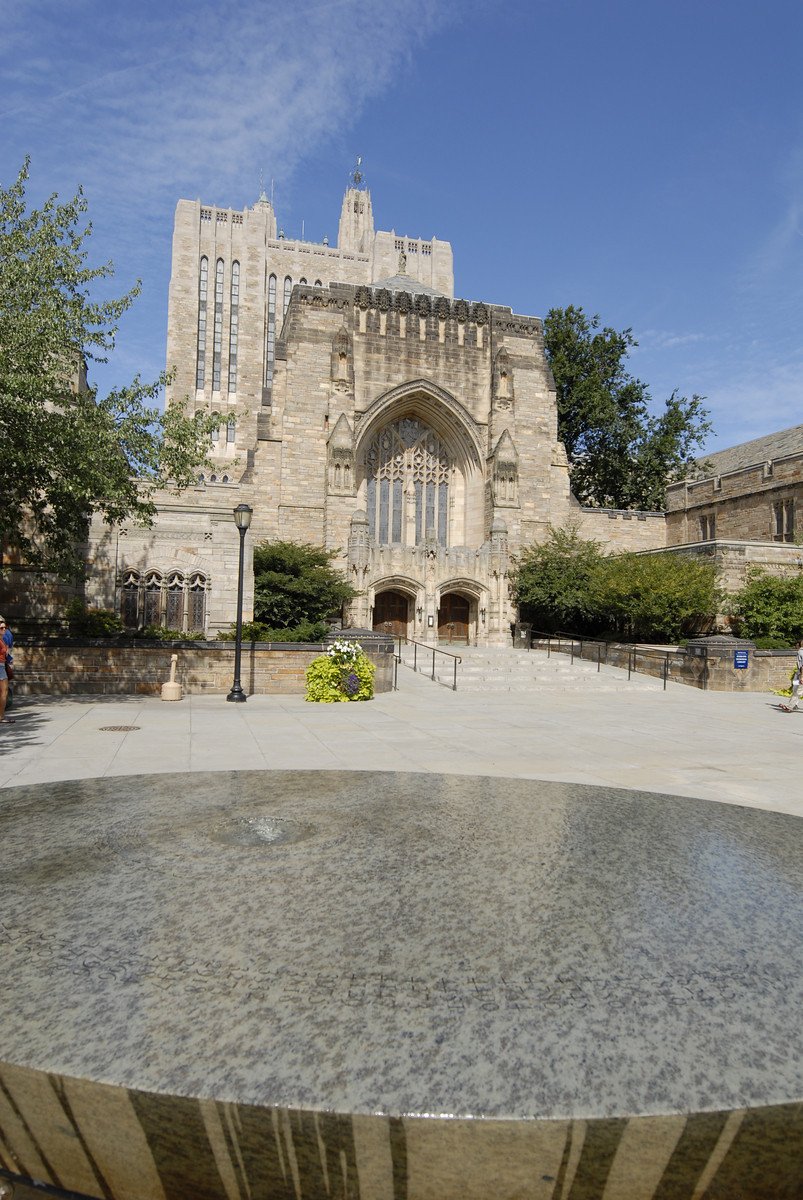
The Maya Lin Studio explains that Lake Placid Blue stone refers to Yale’s color and that the Bembo lettering comes from Yale course catalogs. Water and numbers turn an institutional record into something encountered through reflection, glare, and changing weather. The water may be off for maintenance or seasonal reasons; the work’s meaning does not depend on finding it running on a particular day.
Background
Completed in 1993, the work records the number of women enrolled at Yale by year. Its spiral begins with 1701 and continues through the commission period. For the first 172 years, the engraved count is zero; the work’s sequence first becomes nonzero in 1873.
The Yale University Art Gallery adds an important qualification: later research found that women enrolled when the Yale School of the Fine Arts opened in 1869. The engraved sequence reflects the institutional record used for the commission, not an unchangeable final account of every Yale program. That correction is part of the responsible reading, not a reason to dismiss the work.
Movement and public life
Unlike the other two works here, Women’s Table has remained on Rose Walk since its dedication. Its stability gives it a particular kind of public life. Students and staff repeatedly encounter the numbers without entering a museum. The Yale Gender and Sexuality Studies account emphasizes this daily interaction around the table. Avoid claiming a single response intended by Lin; the documented design explains materials and data, while visitors’ reactions remain their own.
Lipstick: from protest platform to museum stewardship
Present setting
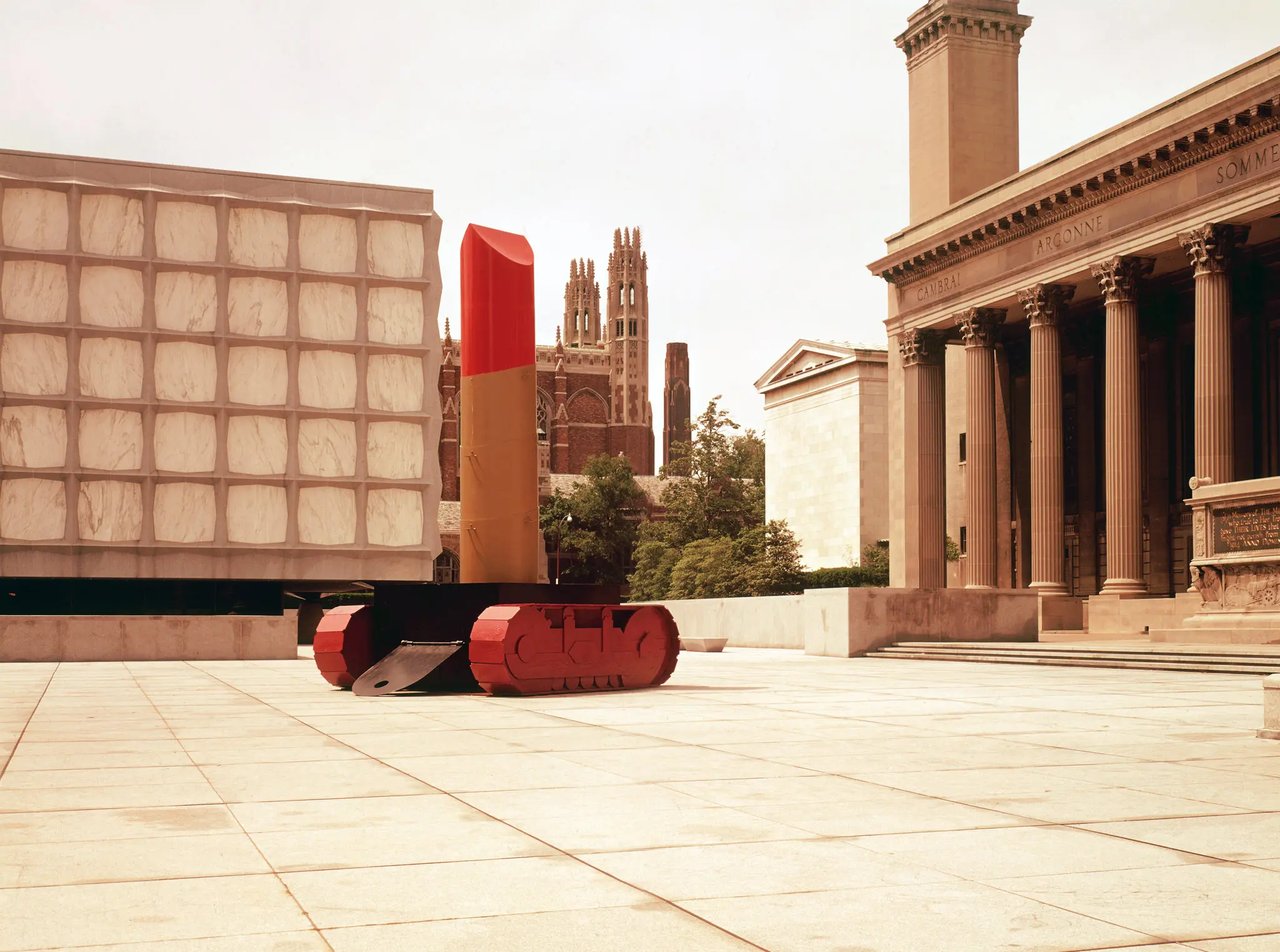
Oldenburg’s sculpture combines a giant red lipstick with dark caterpillar tracks. Soft consumer imagery and military machinery occupy one object, but let the juxtaposition work before assigning it a single message.
Background
In 1969, Oldenburg collaborated with Yale architecture students and the Colossal Keepsake Corporation to install the original version secretly in Beinecke Plaza. The Yale Alumni Magazine archive documents the installation and its charged position near a war memorial and administrative offices. Smarthistory places it within antiwar protest and student gathering.
Movement and controversy
The original lasted about ten months in the plaza. A more durable 1974 version then spent decades in the Morse College courtyard. Conservation work prompted another move in 2025, and current public viewing should be checked with YUAG. Recent reporting by Hyperallergic documents that conservation phase.
The sequence changes the work’s public conditions: open plaza, residential-college courtyard, then museum-managed sculpture setting. It is reasonable to say those settings alter access and supervision. It would be too strong to claim that Yale moved it each time for one political purpose; fabrication, weathering, conservation, and campus management are also documented factors.
Gallows and Lollipops: movement without the same controversy
Present setting
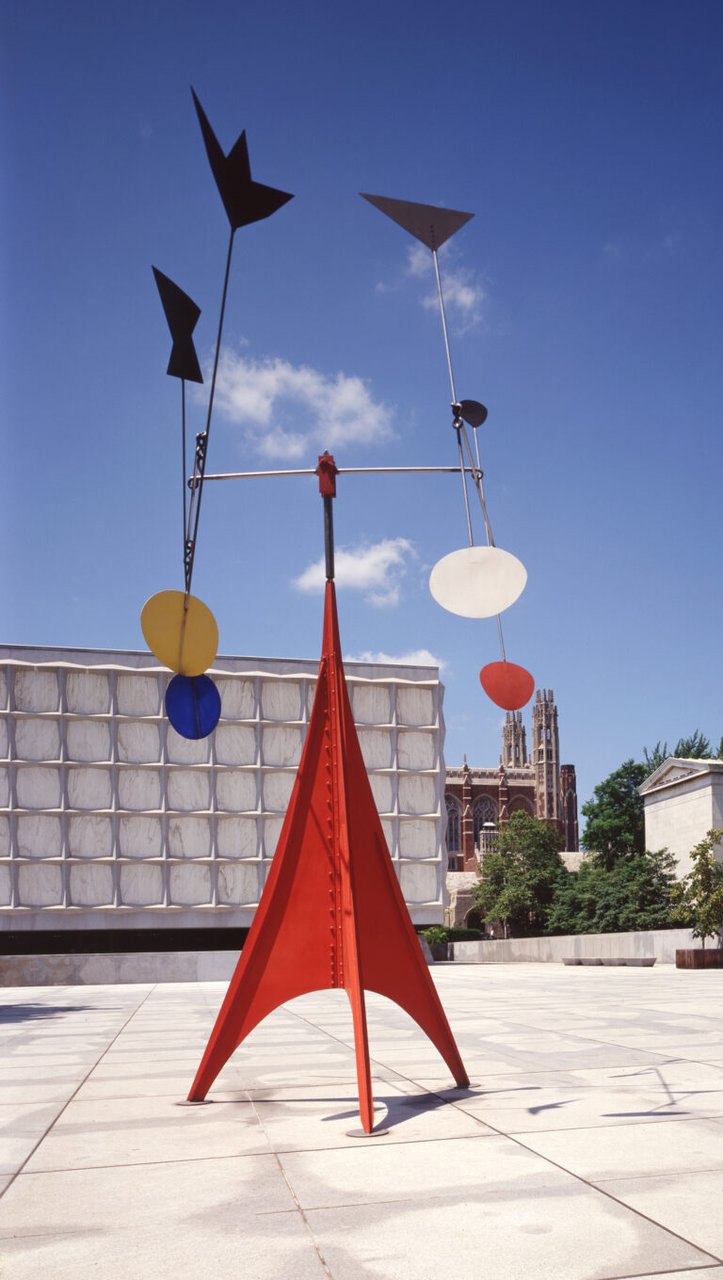
Calder’s 1960 standing mobile uses a red support and suspended colored metal elements. “Standing mobile” means that part of the sculpture is anchored to the ground while other elements can move with air currents. Whether they move during your visit depends on conditions.
Background
The Calder Foundation records the work’s materials, dimensions, date, and 1975 anonymous gift to YUAG. At Beinecke Plaza, its open color and motion contrasted with the pale, fixed masonry around it. That contrast is a site observation, not a claim about Calder’s stated intent.
Movement and campus change
The work was moved from Beinecke Plaza to the YUAG sculpture garden during Schwarzman Center construction, then returned to Hewitt Quadrangle in 2021, as Yale reported. More recent YUAG on-view information has again associated it with the sculpture garden. Treat the current position as time-sensitive and follow the museum map and signs.
Calder’s history provides a useful control case. A work can move because construction, conservation, or display planning changes, even without the same protest history as Lipstick. Location is an institutional decision, but the evidence does not support reading every move as censorship or endorsement.
Read the three works together
Women’s Table places a changing institutional record in a stable pedestrian path. Lipstick moved from a protest-charged plaza into settings with narrower or more managed access. Gallows and Lollipops shows how construction and collection management can relocate a work whose public history is different.
Together, they make one practical point: public art is public through placement as well as subject. A plaza, residential courtyard, walkway, and museum garden do not produce the same encounter. Maintenance and relocation do not erase a work’s earlier meanings, but they do create a new chapter that should be documented carefully.
Five questions to take into the field
- At Women’s Table, where does the spiral first move beyond zero, and what qualification does the 1869 Fine Arts enrollment add?
- How does Rose Walk make the table part of daily movement rather than a formal ceremony?
- At Lipstick, what changes when you imagine the same object in open Beinecke Plaza rather than a sculpture garden?
- At Calder’s work, which elements are fixed, which can move, and how does the current setting affect that movement?
- On a simple map, mark each present location and historical location. Which changes are documented as protest, conservation, construction, or display decisions?