Stand across College Street near its intersection with Wall Street, and you will notice right away that Scroll and Key Hall does not look like a typical Yale classroom, library, or residence. Alternating bands of light and dark masonry stretch across the facade. Arched openings and ornamental frames naturally draw your attention, while the windows reveal very little about the rooms behind them. What the building presents to the street is an elaborate face with almost no explanation.
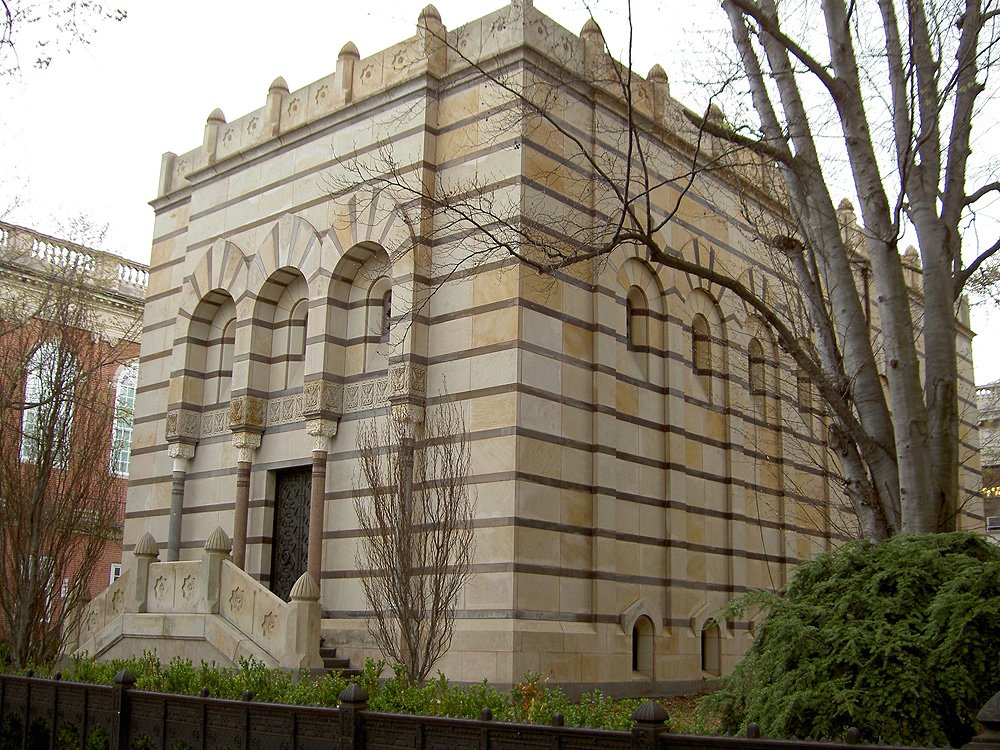
This is the hall of Scroll and Key, a Yale senior society, located at 484 College Street. Yale society halls of this kind are commonly called “tombs.” In this context, the term does not mean a burial place; it describes a closed clubhouse whose interior life is withheld from the public. The New Haven Free Public Library record attributes the building to Richard Morris Hunt and dates it to 1869, while the Library of Congress records the project as completed in 1870. That small difference in dating is worth preserving rather than forcing into false precision.
Scroll and Key belongs to the same broad building type as Skull and Bones, located just a short walk away on High Street. Yet the two halls present secrecy differently. Skull and Bones uses a largely windowless brownstone street front and a recessed entrance. Scroll and Key uses stripes, arches, and ornament to actively solicit attention. One makes refusal look mute; the other gives refusal a striking display surface.
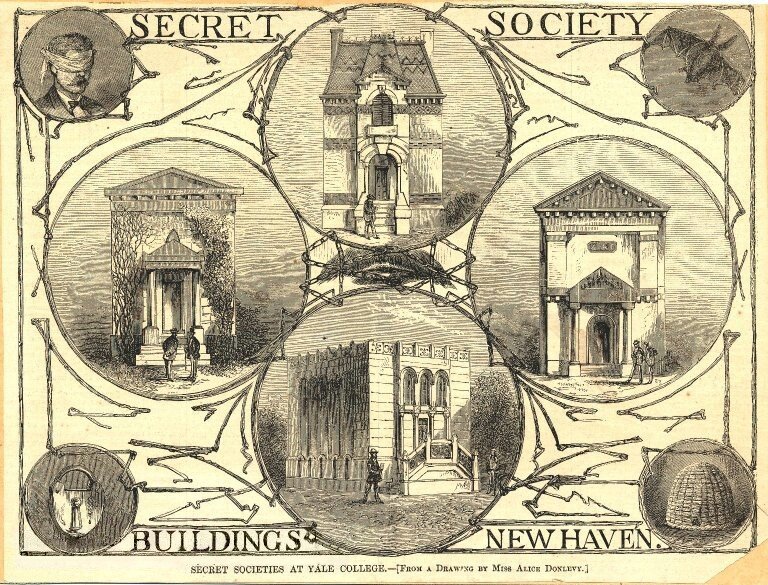
The usual style label for Scroll and Key is Moorish Revival. In nineteenth-century American architecture, that term covered designs that selectively borrowed visual motifs associated with Islamic architecture in North Africa, Spain, and elsewhere. At Scroll and Key, the label directs attention to striped masonry, arches, and an ornamental language markedly different from Yale’s Georgian brick and Collegiate Gothic stone.
This is revival architecture, not a direct reconstruction of a single historical building tradition. Its cultural logic was shaped by nineteenth-century Orientalism: Europe and the United States often treated a broad, internally diverse “East” as a source of exoticism, luxury, and mystery. The building uses that imagined distance to give a private organization a memorable public identity. SAH Archipedia notes that the style was unusual within Hunt’s work.
Hunt was among the first generation of prominent American professional architects trained at Paris’s École des Beaux-Arts. The Library of Congress preserves his drawings for Scroll and Key, including an elevation and plans. You can use them as a check against the current building. The drawings establish authorship and design intent more securely than guesses based only on the facade.
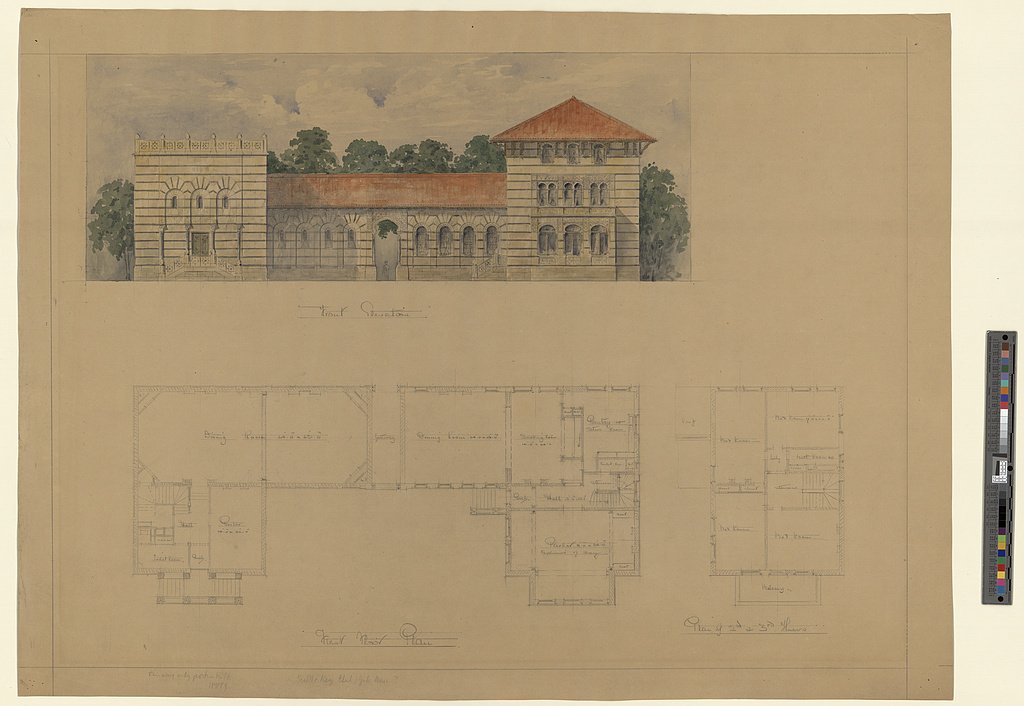
The drawings also clarify what the street cannot. Behind the decorated elevation is an organized building, but the facade does not advertise its rooms as a store, school, or residence might. Its public function is representational: it makes the society recognizable without making it accessible.
That distinction becomes clearer beside neighboring society buildings. St. Anthony Hall, nearby on College Street, has a more open pattern of windows and reads more readily as a conventional clubhouse. The Yale New Haven Building Archive provides a useful comparison. Scroll and Key’s openings remain part of a more guarded, tomb-like composition. Around both stand Georgian and Gothic campus buildings whose styles connect them to Yale’s broader architectural identity. Scroll and Key instead maintains difference as a form of recognition.
While a later addition is often dated to 1901, the available sources do not make that phase central. Subtle facade differences cannot reliably assign individual stones, windows, or wings to precise campaigns without better documentation. Exact proportional ratios, quarry continuity, window-depth effects, sorted stone gradients, and predictable daylong lighting changes may sound plausible, but the sources used here do not establish them.
The more defensible field reading is simpler and stronger. From the public sidewalk, you can verify the horizontal bands, the framed arches, the limited interior visibility, the archival drawing, and the contrast with other society halls. These observations are enough to explain how architecture can make secrecy conspicuous.
That is the paradox to carry away. A private organization needs a boundary, but it may also want a recognizable place in the city. Skull and Bones emphasizes the boundary. Scroll and Key emphasizes recognizability while maintaining the boundary. The facade gives pedestrians plenty to see and little to know.
Do not try to resolve that gap through rumors about members, ceremonies, or interiors. Those stories are both difficult to verify and less instructive than the street itself. The building’s public evidence is its carefully presented exterior and its refusal to translate that exterior into access.
Five field questions
- From across College Street, which element catches your eye first: the entrance, the striped wall, the arched windows, or the cornice?
- After seeing Skull and Bones, how does your attention behave differently at Scroll and Key even though neither building admits the public?
- Compare Hunt’s archived elevation with the present facade. Which similarities and changes can you identify without guessing about their cause?
- How do the number, scale, and apparent openness of windows differ between Scroll and Key and St. Anthony Hall?
- Turn toward nearby Georgian and Gothic buildings. What would Scroll and Key lose if it used the same architectural language as its neighbors?